
Portion & dispensing

Split seasoning can

Direct fill / nested components / repeat demand

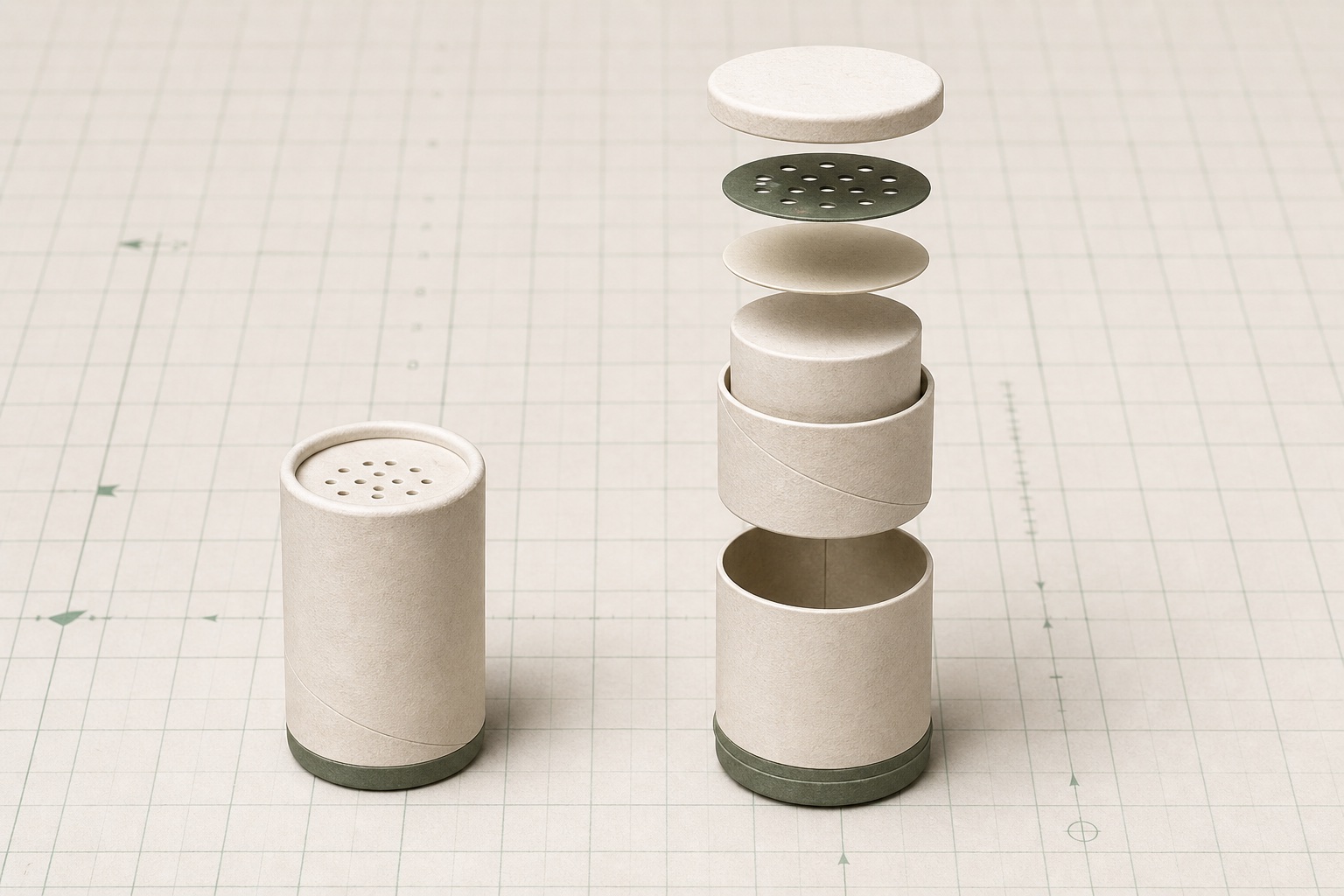
A compact direct-fill format built from two body sections, inner plug, separator and perforated dispensing elements that must nest reliably at volume.

Best for

For direct-fill seasonings that need controlled dispensing and repeatable assembly

Packaging role
Direct fill
Shape
Round / multi-part
Development
Concept direction
Concept visualization / Updated 2026-07-25

Fit before specification.

Use this reference to decide whether the direction deserves project-specific engineering.

Best for

  • For direct-fill seasonings that need controlled dispensing and repeatable assembly
  • Portioned hospitality or aviation formats with recurring demand
  • Programs with enough annual volume to validate a multi-part process
Consider another direction when

  • Product-contact and barrier requirements are still unknown
  • Forecast volume cannot support multi-part assembly development
  • The filling and inspection sequence cannot be validated

What this project must confirm

  • Food-contact and barrier requirements
  • Part nesting and assembly sequence
  • Automation potential
  • Inspection access at small scale

How the product works.

The sequence connects the visible package to the fit, closure and production decisions behind it.

Concept visualization of a small split paper seasoning can and its nested components
Concept visualization

Establish a complete bottom closure for the direct-fill body.

Options and decisions.

Every direction changes fit, appearance, production or commercial logic.

Product-contact route

Project-specific paper-led system

Compatibility, barrier and compliance evidence

Assembly route

Manual sample assemblyAutomation-ready sequence

Repeatability, inspection and volume economics

Dispensing route

Perforated componentProject-specific opening pattern

Dose, access and user experience

Known and project-dependent specifications.

Values are separated by evidence status, so an open decision is never presented as a finished specification.

Known

Filling route
Direct fill
Architecture
Nested multi-part paper-can system

Configurable

Dispensing pattern
Perforation and dose route selected by project
Assembly route
Manual sample or automation-ready sequence

Project dependent

Dimensions
Confirmed around dose, fill and nesting tolerance
Product-contact system
Confirmed against product, market and barrier needs

Validation turns the direction into a product.

Claims, materials and production details apply only to the approved specification and its intended market.

Before quotation

  • Food-contact and barrier requirements
  • Part nesting and assembly sequence
  • Automation potential
  • Inspection access at small scale

Evidence boundary

  • Material, product-contact and market requirements are reviewed against the final use.
  • Claims and certificates are supplied only when applicable to the approved specification.

Sampling and supply.

Commercial facts are confirmed against the approved structure, process, finish and destination.

Minimum order
Confirmed after structure review
Sample lead time
Confirmed after brief review
Production lead time
Confirmed after sample approval
Packing and delivery
Export packing and delivery terms confirmed by destination

Questions before development.

Is this a finished off-the-shelf specification?

No. It is a proven starting direction. Dimensions, materials, fit, decoration and testing are confirmed around the real product and market.

Can we begin without engineering drawings?

Yes. A product description, approximate dimensions, intended market and volume are enough to begin a structured project brief.

Use this product as a reference

Bring the real product into the discussion.

A useful brief can begin with the product, approximate dimensions, target market, likely volume and desired timing.

Start a project